


Marked Tumor Shrinkage After Two Cycles: An Advanced Lung Cancer Patient’s Path to the Right Treatment
-

-
 2026-10-20
-



For patients with lung cancer and their families, the hardest part is often not the moment the report arrives, but the maze that follows a complicated diagnosis — the fog of not knowing which way to turn.
“Advanced.” “Metastatic.” “Gene mutation.” …
Stacked together, these words can easily make it feel as if the options had run out.
Yet clinical practice has proven, again and again, that what truly determines the direction of treatment is never any single diagnosis, but whether the essential nature of the tumor can be seen in full.
Initial diagnosis: facing a complex and critical illness
This was a patient with lung adenocarcinoma. On arrival at the Thoracic Oncology Center of Heyou Hospital, imaging showed stage IV lung adenocarcinoma with suspected metastases to the liver and kidneys.
For the patient and family, the most immediate weight of such a result was the knowledge that “the disease was no longer only in the lung.” For the physicians, it meant that treatment could not rest on applying a protocol from experience: every detail had to be examined deeply, to find a possibility worth fighting for.
What many patients with advanced lung cancer fear most is not only the complexity of the disease, but the helplessness of feeling that “nothing more can be done.”
But the more complex the case, the less one can afford to stop at the two words “advanced.”
When no way seems open, look deeper
Further testing revealed a KRAS p.G12D mutation.
When families see the words “gene mutation,” many immediately think of targeted drugs. And when the mutation turns out to be an uncommon type without a clearly matched drug, spirits often sink at once.
But genuine clinical decisions have never rested on a single site.
In the evaluation at the Thoracic Oncology Center of Heyou Hospital, the team did not stop at the KRAS mutation; they went on to complete a fuller biomarker analysis.
Because lung cancer treatment today depends less and less on “having one result,” and more on whether several results, placed side by side, can piece together a path that is truly workable.
More than one mutation determines the direction of treatment
After in-depth analysis, new clues emerged: the patient also showed ultra-high PD-L1 expression, and both TROP2 and Nectin-4 were positive.
Far from complicating the report, these markers pointed clearly in one direction: difficult as the case was, it was by no means beyond treatment — the patient had strong potential to benefit from immunotherapy.
The key to this case lay not in asking, in isolation, “what to do about the KRAS mutation,” but in reading the pathological type, the molecular features, and the immune-related information together, and re-judging which path was most likely to bring benefit.
On this basis, the team designed a combined regimen of pemetrexed + cisplatin + sintilimab.
This was not a “let’s try and see” — it was an individualized choice built on a complete evaluation.
After two cycles of treatment, the turning point arrived
What truly let the patient and family see hope again was the restaging result.
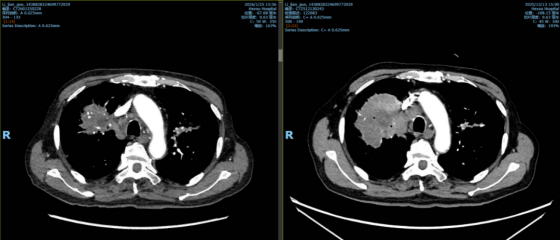
After 2 cycles of the combined treatment, restaging scans showed that the primary tumor in the lung had shrunk markedly, and the liver metastases had shrunk in step — a response assessed by the treating team as a partial response (PR).
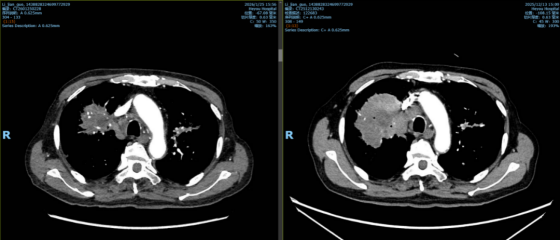
Chest CT images from the restaging evaluation, as reported by the treating team.
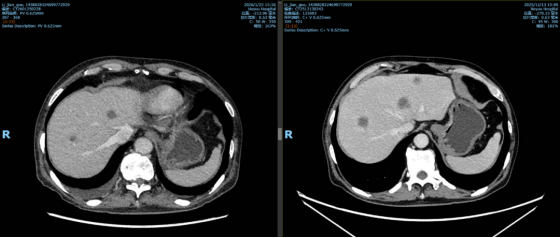
Abdominal CT images of the liver metastases at restaging, as reported by the treating team.
For the physicians, this was an ideal treatment response. For the patient and family, it meant that a heavy and uncertain situation had finally shown a clear signal of “moving in the right direction.”
Many patients with advanced lung cancer find it hardest to bear not the treatment itself, but the uncertainty before it — the not knowing whether it will work.
And the meaning of this case lies precisely here: when the evaluation is thorough enough, even a seemingly impassable situation can find its turning point.
What this case is truly meant to show
If this case were understood only as “a regimen that worked,” its significance would be greatly underestimated.
What it really shows is this: in advanced lung cancer — especially with metastases at multiple sites and complex molecular features — the greatest danger is not the complexity itself, but walking into a fixed pathway before the disease has been seen clearly.
Modern lung cancer treatment is less and less a contest of any single modality.
What truly matters is whether fuller testing and more systematic evaluation can restore the patient from “a case of lung cancer” to “a person with specific features and a clear direction of treatment.”
For the Thoracic Oncology Center of Heyou Hospital, this case confirms once again: the meaning of precision medicine is not to put every patient on the newest regimen, but to help every patient, as far as possible, onto the path that suits them best.
The road of advanced lung cancer treatment is never easy.
But more and more clinical practice is telling us: even in the most complex situation, when the evaluation is deep enough and the path clear enough, an active treatment response and the hope of survival can still be won.
In closing
There has never been only one answer in lung cancer treatment.
Some patients need to fight for a surgical opportunity; some need radiotherapy for local control; some are treated primarily with systemic therapy; and some complex advanced cases depend, above all, on finding an individualized plan through precise evaluation.
Through this case, the Thoracic Oncology Center of Heyou Hospital hopes that more patients and families will see: when facing lung cancer, what matters is not only “whether there is a way,” but whether the patient has truly been seen clearly.
When a complex problem is seen clearly, treatment is no longer a matter of passive endurance —
it becomes the initiative to break through, and a new turning point.
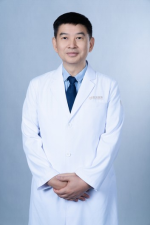
The Doctor in This Case: Dr. Kang Shijun
Director of Medical Oncology
More than 30 years of clinical oncology experience at Nanfang Hospital, Southern Medical University. Postdoctoral training at the University of Chicago and senior visiting scholarship at the University of Illinois Chicago.
Clinical focus: lung, breast, esophageal, hepatobiliary, pancreatic, and head and neck cancers.
Treatment expertise: targeted therapy, immunotherapy and minimally invasive treatment combined with chemotherapy and radiotherapy; radiofrequency and microwave ablation; thoracic and abdominal hyperthermic perfusion.

Scan to follow Heyou Cancer Center and learn more about cancer care.
Heyou Cancer Center
Science in treatment. Humanity in care.


