Rectal Cancer at 96: Is Treatment Still an Option? A “Tailored” Radiotherapy Plan for One Elderly Patient
-

-
 2026-10-20
-



At 96, should a cancer still be treated?
For many families, the first response to a cancer diagnosis in a very elderly loved one is often not "how should we treat this?" but: Can it be treated at all? Is it worth treating? At this age, is letting go the only option? For one 96-year-old man and his family, the same question was about to become very real.
In 2025, he gradually began to notice his stools becoming narrower, increasing constipation, and a small amount of fresh blood in the stool. At first, he and his family attributed it to age and to hemorrhoid bleeding. As the symptoms steadily worsened, however, the family began to sense that something was wrong. In late August 2025, they took him to a local hospital. Blood tests showed elevated intestinal tumor markers, and colonoscopy revealed a mass about 10 cm from the anal verge, encircling roughly one-third of the bowel lumen, with ulceration on its surface — highly suspicious for malignancy. Biopsy confirmed the diagnosis: rectal adenocarcinoma.
This meant the problem was no longer simple "inflammation" or a "polyp," but a malignant rectal tumor that had to be faced in earnest.
At 96, the hard part is not “knowing” — it is “choosing”
For many families, the truly difficult moment is not learning that "there is a tumor." It is the question that follows: at 96, treat or not?
At this age, the body’s reserves have declined, and many treatment options must be weighed with special caution. Yet it is also precisely at this age that any worsening of symptoms — eating, sleeping, toileting — can directly affect the comfort and dignity of this final chapter of life.
The family consulted two or three local hospitals, and all of them advised: "At his age, let it be." But his symptoms kept getting worse, and hoping that one more consultation might offer one more possibility, the family came to the Cancer Center of Heyou Hospital.
Dr. Tan Zhibo, the treating physician, analyzed the case carefully. The imaging showed that the tumor had grown outward through the bowel wall, and inward it was blocking nearly half of the intestinal passage, with metastases to the surrounding lymph nodes. This was not an early-stage tumor. Left untreated, the constipation, the bowel obstruction, and the bleeding would only continue to worsen — affecting not only quality of life and survival, but also raising the risk of an acute emergency that would be far harder to manage.
After patiently listening to the family’s wishes and discussing the situation with them fully, the team developed a treatment strategy of "relieving symptoms first, extending life where possible along the way": radiotherapy as local treatment, with the aim of controlling and shrinking the tumor. As the tumor shrank, the bowel obstruction and bleeding were likely to ease; and controlling the disease could also help extend his life to a degree.
In the details of implementation, his advanced age shaped every decision. The radiotherapy plan was individualized: moderately reducing the treatment volume and appropriately lowering the radiation dose to reduce side effects — deliberately not pursuing complete eradication of the tumor.
Because what this elderly patient faced was not a choice to "push the heaviest treatment," but the search for a more realistic goal: on a foundation of safety, to control the local disease as much as possible, relieve symptoms, and improve quality of life.
Not “irradiating a wide area,” but planned, precise radiotherapy
From September to October 2025, the patient received radiotherapy directed at the primary tumor and the surrounding regions of involved lymph nodes.
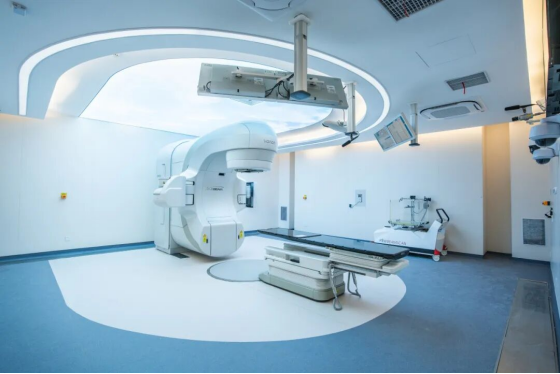
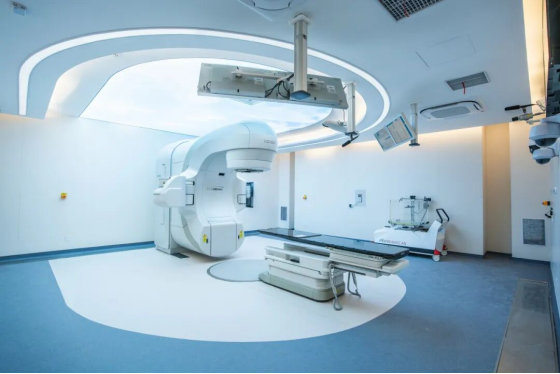
The linear accelerator at Heyou Cancer Center.
Technically, the center used image-guided volumetric modulated arc therapy (IGRT/VMAT).
Many patients and families find such terms unfamiliar. Put simply, the core value of this technique is to cover the tumor and the regions at highest risk as precisely as possible, while sparing normal tissue from unnecessary radiation. The primary tumor and the involved lymph nodes received relatively high doses; the related lymphatic drainage regions were irradiated prophylactically, with the protection of normal tissue as the precondition.
For a 96-year-old, completing a full five-week course of radiotherapy without interruption is no small achievement in itself. Behind it lies the most essential point in treating the very elderly: not blindly pursuing what is "stronger," but what is more appropriate, more tolerable, and more likely to bring real benefit.
In addition, at the planning stage Dr. Tan joined Dr. Jiqun Yi, senior consultant of medical oncology, in discussing reduced-dose oral chemotherapy with the family — a treatment that could be stopped at any time if side effects occurred. After weighing the risks and side effects that chemotherapy can carry, the family ultimately decided against it.
After radiotherapy, the first thing to change was the most practical matter of all: bowel movements
Many people judge cancer treatment by one question first: "Has the tumor shrunk?" For an elderly patient, what often matters more is: Can he eat now? Can he sleep? Is toileting still an ordeal?
This gentleman did remarkably well. He experienced no acute radiation reactions during treatment, and as radiotherapy progressed, the symptoms that had troubled him showed real, tangible change:
• Bowel movements, difficult before treatment, improved markedly
• The blood in his stool had disappeared
• No melena and no mucus in the stool
In a younger patient, these changes might simply be called "symptom improvement." In a 96-year-old, they often mean:
• less worry from bleeding
• less torment with each visit to the toilet
• less risk of losing strength and appetite as symptoms worsen
• and a lower risk of a sudden emergency in the future
Often, the meaning of cancer treatment is not measured only in a few cold lines of a medical record, but in whether a patient’s days can be a little easier, a little more comfortable, a little more dignified.
96 does not mean giving up; elderly care is never about being “aggressive”
This story may not be one of those "dramatic reversals."
But it carries a meaning just as important: advanced age, in itself, is not a reason to abandon treatment.
Of course, this does not mean all elderly patients should receive the same treatment. Quite the opposite: the older the patient, the more careful the evaluation must be, and the more clearly the goals of treatment must be defined.
What treatment for elderly cancer patients should truly strive for is often not the "most aggressive therapy," but:
• Can the condition be assessed clearly?
• Can a plan be chosen that his body can tolerate?
• Can the disease be controlled while preserving quality of life as much as possible?
• Can the days that remain be free from repeated torment by symptoms?
Seen from this angle, what this 96-year-old patient’s precisely delivered radiotherapy achieved was not only a course of treatment itself, but an active safeguarding of his quality of life.
Elderly patients are not “untreatable” — they need treatment “tailored to fit”
On this, Jiade Jay Lu, MD, MBA, President of Heyou Cancer Hospital, said: for elderly patients with rectal tumors, what clinical practice most needs to avoid is often two extremes:
• one is to simply give up all active treatment because of age;
• the other is to blindly pursue overly aggressive treatment regardless of the patient’s physical condition.
Truly sound treatment, he noted, should be built on a comprehensive assessment of the extent of disease, the patient’s physical status, symptom burden, and treatment tolerance.
In this patient’s case, the disease was no longer early-stage, and local symptoms were already affecting his life. Under these circumstances, the value of radiotherapy lay not only in controlling the local tumor, but in relieving bleeding, easing difficult bowel movements, and helping the patient maintain his basic daily life.
In other words: elderly patients are not untreatable — they need treatment "tailored to fit."
For elderly cancer patients, the goal of treatment should not focus only on the tumor itself, but also on the patient’s overall condition and quality of life.
Helping a patient bleed a little less, struggle a little less with bowel movements, and feel a little less local discomfort is itself a valuable treatment benefit.
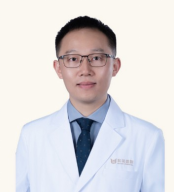
The Doctors in This Case : Dr. Tan Zhibo
Associate Chief Physician and Master’s Supervisor
A visiting scholar at University College London, Dr. Tan previously worked at Peking University Shenzhen Hospital. His clinical focus includes precision radiotherapy and multidisciplinary care for breast, lung, rectal, and prostate cancers.
His treatment expertise includes intensity-modulated radiation therapy (IMRT), volumetric modulated arc therapy (VMAT), image-guided radiation therapy (IGRT), stereotactic body radiation therapy (SBRT), and adaptive radiation therapy (ART). He also uses respiratory motion management approaches, including real-time tracking, optical surface monitoring, and respiratory gating.

Dr. Jiqun Yi
Senior Consultant, Medical Oncology
Chief physician with more than 30 years of oncology experience. Former Director of Oncology at Guangzhou Red Cross Hospital.
Clinical focus: breast, lung and gastrointestinal cancers, and lymphoma; chemotherapy, endocrine, targeted and immune therapies, with pain, nutrition and other supportive care.

Scan to follow Heyou Cancer Center and learn more about cancer care.
Heyou Cancer Center
Science in treatment. Humanity in care.