


Three Stories, One Kind of Warmth: Cancer Care Designed for the One and Only You
-

-
 2026-10-20
-

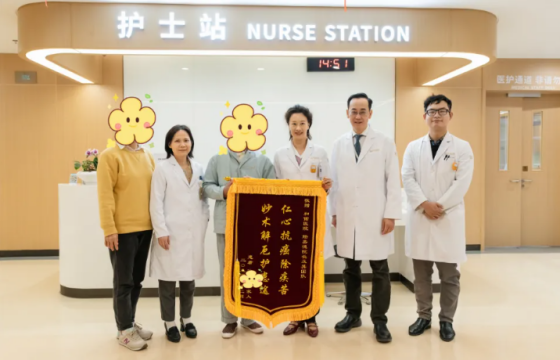


"I am not a case. I am a living, breathing person."
This year’s World Cancer Day theme, "United by Unique," carries a simple conviction: every life is unique, and the mission of medicine is to bring all of its strength together in defense of that uniqueness.
At the Cancer Center of Heyou Hospital, every patient arrives with a story of their own. Many come carrying fear and uncertainty — and find, through careful treatment and steady human support, a new coordinate for their lives.
Below, two patients tell their stories in their own words, alongside a treatment note from the attending physician who cared for a third.
Ms. Li, 60: The “balloon” that was about to crush me was gently taken down
"After the 'balloon' appeared on my neck, I felt like a monster."
I had been living with ovarian cancer for seven years. Last autumn, a large mass appeared on the right side of my neck. It kept growing — swelling like a balloon, breaking through the skin, painful and draining constantly. My right arm swelled so badly that I could no longer lift it, and every day I went out wrapped in thick gauze.
I went from hospital to hospital, and doctor after doctor shook their heads. Some said it was too late; some said they could not promise anything. One doctor put it gently: "Go home and rest well." I knew exactly what that meant.
"With one last thread of hope, I came to Heyou."
The doctor who saw me did not begin by saying whether anything could be done. Instead, he said: "We will convene a multidisciplinary meeting right away and look at this together." The next day, I met what felt like a whole team — specialists from radiation oncology, medical oncology, surgery, and imaging, and even nutrition and wound care. Professor Lu Jiade told me: "Your case is indeed complicated. But we will design a plan that belongs to you alone."
They explained it in words I could understand: the "balloon" was a metastasis. First they would use precision radiotherapy to strike it, then chemotherapy would follow, clearing the small scattered pockets of disease elsewhere in my body. What reassured me most was that they had already thought ahead about the risk of skin breakdown after radiation, and arranged for wound care nurses to stand by me through the entire course of treatment.
And through it all, there was Sun, my patient care coordinator. She was like a navigator for my medical journey: she coordinated every examination before I even thought to ask, and explained each complicated step until it made sense. Whenever the anxiety rose, one phone call would reach her calm, gentle voice, patiently helping me sort through my worries. I never had to carry the helplessness alone.
"It turns out that even the sound of wound debridement can be gentle."
Once treatment began, I went for radiotherapy every afternoon. It did not hurt and it did not burn — it felt like having a CT scan. Afterwards, I would go to the clinic for dressing changes.
The nurses were unfailingly gentle. "Ms. Li, how are you feeling today?" "Let’s take a look at the wound — mm, it’s cleaner now." They removed the dead tissue with hands that were light and precise, chatting as they worked, telling me about other patients who had gone on to recover. Listening to the quiet sounds of the instruments, and feeling the weight on my neck ease a little day by day — for the first time in seven years, I felt at peace during treatment.
Four weeks later, the "balloon" had visibly deflated. Three months later, the mass was gone.
My daughter, who had been through all seven years beside me, said: "Mom, at Heyou I finally saw the warmth in 'medical care.'" What is that warmth? It is that they considered my dignity when designing the plan, and tended to my fear while treating me. It is being made to feel not like a difficult problem waiting to be dealt with, but like a person they were doing everything in their power to help.
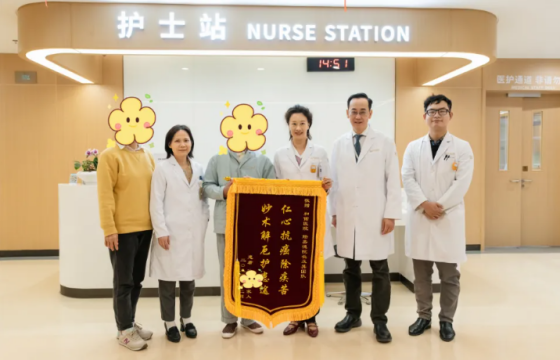
Ms. Li and her family with the care team at Heyou Cancer Center.
Medical perspective: For recurrent metastatic cancer invading the skin and muscle this extensively, the multidisciplinary team at Heyou Cancer Center developed an individualized plan — precision radiotherapy combined with chemotherapy, supported throughout by meticulous wound care — aiming to control the tumor while preserving the patient’s quality of life and dignity.
Ms. Wu, 60: “Oligometastasis” was not a final verdict — it was a window of opportunity
"The words 'lung metastasis' on my report felt like a death sentence."
Two years earlier, I had undergone surgery for rectal cancer and gotten through chemotherapy. I thought I had finally reached the shore. Then at a routine follow-up last year, the doctor pointed to a small spot on the CT images: "There is something new in the lung." In that moment, the sky fell. All I could think was: it has spread — is there no hope left?
"Professor Lu said to me: don’t panic — this may still be an 'opportunity.'"
At Heyou, the team ordered a more detailed PET-CT evaluation. The conclusion surprised me: this was not widespread disease throughout my body, but a single, solitary lesion — what medicine calls "oligometastasis."
Professor Lu Jiade and Dr. Tan used an image to help me understand it: "Imagine the main force of the enemy has not yet arrived — only a small detachment has slipped in. This is precisely our best window to strike with accuracy and turn the situation around." They decided to use a technique called SBRT — stereotactic body radiation therapy — working like an invisible scalpel to treat this single lesion with high precision. They also performed genetic testing and combined chemotherapy with targeted drug therapy.
"Scientific evidence is the best reassurance."
Before treatment, my heart still wavered. Dr. Tan brought up the international studies — the SABR-COMET trial — and showed me the data: for patients like me, this kind of active local treatment was associated with median survival nearly doubling in the trial. "We have sound scientific grounds to be optimistic — together," he said.
Treatment itself was quick, completed in a few sessions, with little discomfort. One month later, at the follow-up, the small white spot on the CT images that had kept me awake at night had become almost invisible, as reported by the treating team.
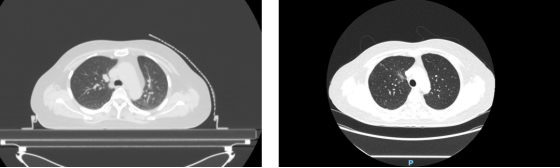
CT comparison images from Ms. Wu’s treatment and follow-up, as reported by the care team.
Now I believe it: "metastasis" no longer has to be a vague and despairing word. With the progress of medicine, doctors can analyze a disease as unique as mine the way an engineer disassembles a precision instrument — find the single most critical "switch," and press the restart button of hope for me.
Medical perspective: Oligometastasis represents a critical window in cancer treatment. Following international guidelines, Heyou Cancer Center uses multidisciplinary team (MDT) evaluation to identify suitable patients and applies radical local treatments such as stereotactic body radiation therapy (SBRT), seeking the possibility of long-term survival — and in selected cases, clinical cure. Careful scientific assessment and precise intervention are the source of that confidence.
Mr. Gao, 83: “I no longer want to go to war” — the “guardian of peace” plan we designed for him (as told by his attending physician)
As his attending physician, I still remember clearly the day I first met Mr. Gao and his family. A thick medical record lay before us: an 83-year-old man with multiple primary tumors — colon, liver, rectum, and prostate. His children’s faces were full of anxiety, and of hesitation.
They had gone from hospital to hospital and heard almost the same plan everywhere: surgery, radiotherapy, chemotherapy — a full combination that even a younger person would struggle to endure, let alone a man in his eighties. The family expressed their wish in the simplest and most resolute terms: "We want treatment — but we want him to keep living well. We do not want him lying in a hospital suffering."
That sentence became the starting point of every plan we made. At Heyou Cancer Center, we believe the goal of treatment must be aligned with what the patient wants from his own life. For Mr. Gao, the goal was not "cure." It was "protection" — protecting his dignity and the everyday calm of his life.
We quickly convened a multidisciplinary team. Specialists from gastrointestinal surgery, gastroenterology, urology, imaging, nutrition, and pathology sat down together, and the focus of the discussion was very clear: how to control the disease effectively while interfering as little as possible with his life. In the end, we jointly designed a plan of "precise management": first, oral chemotherapy combined with targeted therapy to gently control the most actively growing colorectal lesions; once the disease had shown itself responsive and he was tolerating treatment well, hormonal therapy would follow for the prostate tumor.
The essence of this plan is balance. We no longer insisted on the complete disappearance of the tumor on imaging; instead, we pursued a kind of clinical "stable coexistence" — letting the disease slow down while helping him feel better. Mr. Gao would not need long hospitalizations. He would return to the hospital regularly — targeted therapy once every three weeks, hormonal therapy once every three months — and the rest of the time he would take his medication at home on schedule, keeping the rhythm of his own life.
We told the family: "Please do not worry. Let him live the way he always has — take his medicine on time, go to the park in the afternoon, play his cards and chess." In the months since, at every follow-up visit we have watched his tumor markers fall steadily and his imaging show the disease under control. And the family tells us: "Father is eating and sleeping well, and his spirits are very good." Each time, we feel genuinely gratified.
This case taught me something profound: the "goodness" of medicine lies not only in the sharpness of its technology, but in the warmth of its choices. For an elderly patient burdened with many illnesses, the most humane treatment may not be the most aggressive one — but it must be the one that best fits the rhythm of his life. What we designed for Mr. Gao was not a battle manual, but a "guide for living well," built on full respect and careful scientific evaluation.
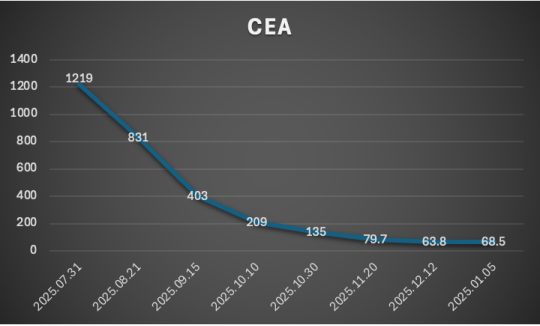
Trend of the tumor marker CEA over the course of treatment (July 2025 – January 2026).
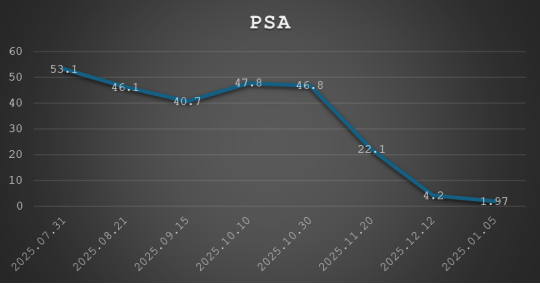
Trend of the tumor marker PSA over the course of treatment (July 2025 – January 2026).
Medical perspective: For elderly patients with multiple primary tumors and conservative treatment goals, the multidisciplinary team at Heyou shifts its core objective from cure toward long-term, high-quality coexistence with the disease. Through stepwise, sequential, low-toxicity yet effective individualized therapy, the team works to control disease progression while maximizing the patient’s quality of life — the practice, in concrete form, of patient-centered care.
You, one of a kind
Deserving of everything we can unite
Three accounts. Three perspectives. Three unique circumstances of life.
What they shared was this: when they walked into Heyou, not one of them was treated as a standard “colorectal cancer patient” or “prostate cancer patient.” They were, first of all, a frightened but resilient mother, a daughter searching for scientific grounds amid her despair, and an old man who deserved a peaceful later life.
Precisely because each of them is so “unique,” medicine must summon all of its wisdom and gather all of its strength to achieve an unprecedented “United” — medical oncology, radiation oncology, surgery, imaging, pathology, nutrition, nursing... specialists from more than a dozen disciplines, sitting down together for one irreplaceable life.
“United by Unique.”
This is not only the theme of World Cancer Day. It is what modern cancer care should look like: because you are one of a kind, we must unite everything we have to design the path forward that belongs to you alone.
Here, technology is at once a cold microscope and a warm light in the dark; the ward is both a rigorous battlefield and a harbor of trust. Because everyone here believes: every life’s story deserves an ending full of warmth.
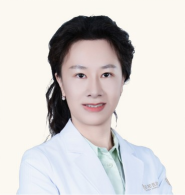
The Doctor in This Case: Dr. Yang Jing
Associate Chief Physician, Radiation Oncology
Doctorate in oncology from Sun Yat-sen University; visiting scholar at Massachusetts General Hospital, USA. Previously practiced at Shanghai Proton and Heavy Ion Center.
Clinical expertise: nasopharyngeal, head and neck, skull base and central nervous system tumors, and bone and soft tissue sarcomas; photon, proton and carbon ion therapy, IMRT and multidisciplinary care.

Scan to follow Heyou Cancer Center and learn more about cancer care.
Heyou Cancer Center
Science in treatment. Humanity in care.


